

How to Choose a Packraft: Size, Weight, and Water Class
Most people choose a packraft based on the hardest water they can imagine paddling. That is the wrong end of the problem. Buy for the trips you will actually take ninety-five percent of the time, not the trip you might take once.
Start with intended use
If most of your paddling is alpine lakes, slow rivers and the occasional easy rapid, an ultralight boat is the right call and the weight savings will matter on every approach. If you are hauling gear for multi-day trips, or carrying game or a bike, capacity matters more than the last pound of weight. If you are running technical rapids, you want a whitewater-focused hull and a spray skirt.
Then weight and packed size
Weight is the entire point of the category, but it trades against durability and capacity. A rough guide:
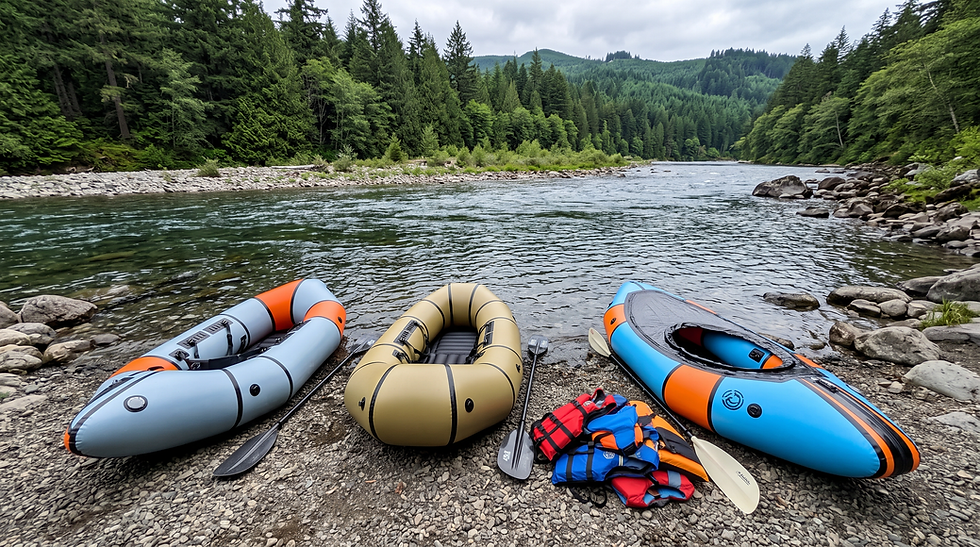
5 to 6 lbs: ultralight. Best for thru-hiking, bikerafting and long approaches where every ounce is carried on your back. Our Carver sits here at 500 to 600 lb capacity.
7 to 9 lbs: the versatile middle. Enough capacity for real expedition loads without a weight penalty you will notice. The Badger, Stance and Element live in this range.
13 to 14 lbs: tandem and heavy-haul. Two paddlers or serious cargo. The Glacier carries 1,000 to 1,100 lbs.
Then size and fit
Sizing is driven by your height and how much gear you carry. Length determines legroom and glide; too short and you are cramped, too long and the boat is heavier and less responsive than it needs to be. If you are tall or planning overnight trips, size up. The extra cargo room is worth more than the few ounces.
Interior length is the number that matters, not overall length. A boat with thick tubes has far less usable space inside than its outer dimensions suggest.
Water class
Class I to III covers the vast majority of paddled river in North America, and it is what well-built packrafts are designed around. Above that you are into specialized territory where hull design, outfitting and paddler skill all have to line up. Be honest about where you paddle now, not where you hope to paddle in three seasons.
Budget for the whole kit
The boat is not the only cost. Plan for a paddle, a PFD, and cold-water clothing. A four-piece packable paddle runs anywhere from $100 to $400, a PFD from $80 to $300, and a drysuit can exceed $1,000 if you paddle cold water. Factoring this in from the start prevents the common mistake of spending the entire budget on the boat and paddling in unsafe clothing.
What to look for in construction
Shell fabric: TPU-coated nylon, typically 210D, balances weight against tear resistance.
Floor: a reinforced layer, ideally 420D with Kevlar, is what survives contact with gravel and rock.
Valve: a removable, replaceable valve means a failure does not end the boat's life.
Internal storage: a sealed chamber accessed by an airtight zipper keeps gear dry and lowers your center of gravity.
Repair kit and warranty: both should be included, not optional.


Comments